When Do DPP, the AI Act, and GDPR Become Real Leverage?

When EU regulation is discussed, management teams usually make two mistakes.
The first is to read each new regime as a separate legal folder.
The second is to miss the fact that these regimes can jointly create a new product and operating logic.
That is exactly what is happening with the Digital Product Passport, the AI Act, and GDPR.
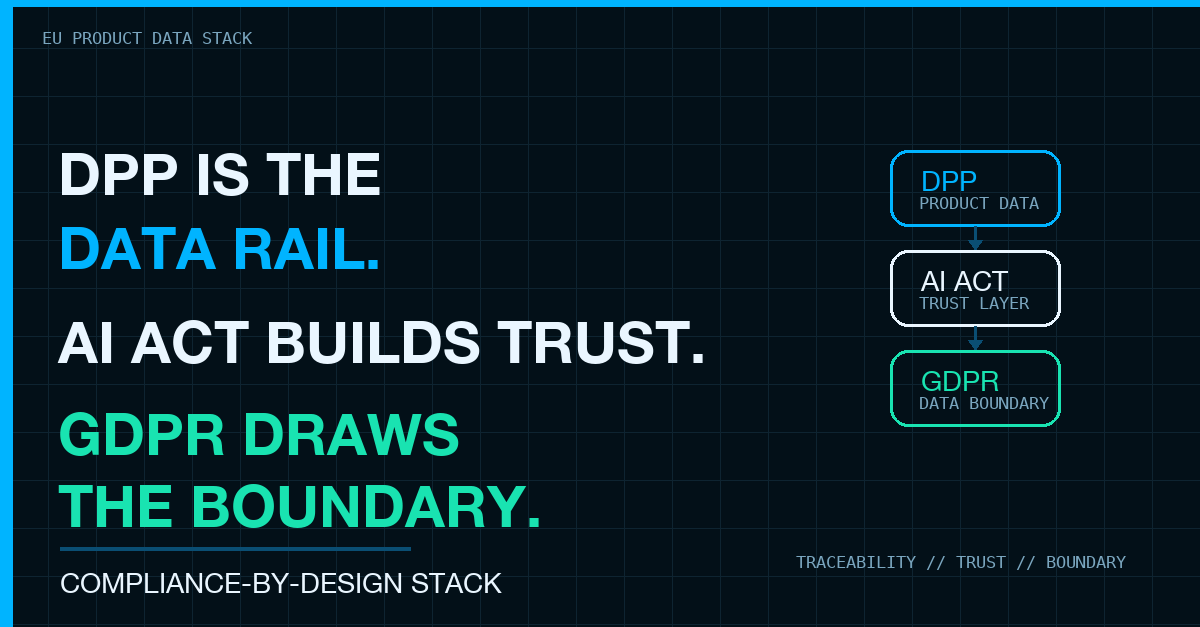
These three frameworks do not regulate the same thing. But they do pressure different layers of the same system:
- DPP builds the product's digital identity and evidence backbone.
- The AI Act disciplines the automation and decision layer running on top of that backbone.
- GDPR draws the boundary when that system touches people and personal data.
That is why the clearest formula is this:
DPP is the data rail. The AI Act is the trust rail. GDPR is the boundary rail.
If a company gets these three right, it does not merely become compliant.
It begins to build its own supply-chain software logic.
Why DPP Is the Starting Point
The Digital Product Passport forces product-related data to become machine-readable, traceable, and defensible.
That means:
- product and component identity
- material and conformity data
- performance and lifecycle information
- evidence behind claims
can no longer live in scattered Excel files, PDFs, and supplier email chains.
So DPP is not just a question of "what information do we display?"
It is really a question of "what data model are we going to live with?"
Most companies are still standing in the wrong place.
They either treat DPP as a labeling task, or assume they can wait for delegated acts and still move in time at the last minute.
But the real bottleneck is not the regulation itself.
The real bottleneck is the ability to collect supplier evidence and connect it to a coherent data backbone.
Where the AI Act Sits in This Picture
This is where leverage starts to appear.
DPP on its own can remain a passive compliance layer.
But once the same data foundation is paired with AI, it becomes an active operating system.
Examples include:
- detecting missing supplier data
- flagging inconsistent claims or document anomalies
- prioritizing higher-risk areas
- automating conformity workflows
- accelerating buyer questionnaires and audit responses
The strategic question is this:
Are we building this data stack to archive evidence, or to power a trust machine that supports decisions?
If the answer is the second, the AI Act enters the picture.
Because the issue is no longer simple storage. It becomes the safety, traceability, and governability of the automation running on top of that data.
But one mistake must be avoided:
Not every DPP project is fundamentally an AI Act project.
A static passport and an AI layer that materially shapes decisions are not the same thing.
If that distinction is not made early, teams either overreact or under-manage the issue.
Why GDPR Is Not a Brake but a Design Boundary
In this triangle, GDPR is usually either overstated or noticed too late.
As long as DPP remains product-centered, GDPR pressure may stay limited.
But the moment passport architecture starts carrying:
- technician or operator records
- device owner or end-user information
- location and usage traces
- service and warranty flows linked to individuals
the issue changes immediately.
This is the core tension:
- DPP pushes for more traceability.
- GDPR pushes for data minimization and purpose limitation.
The right answer is not to throw both into a single system.
The right answer is this:
Separate the product layer from the person layer. Unify the data backbone, not the access model.
Without that separation, companies think they are building a single source of truth, while in reality they are building a single source of risk.
Where the Real Commercial Leverage Emerges
The real value of these three regimes is not in writing compliance reports.
It is in creating procurement trust, supplier onboarding speed, and audit defensibility.
The strongest productization opportunities are here:
1. Supplier Evidence Engine
DPP collects supplier data.
AI cleans it, maps it, scores it, and identifies missing evidence.
GDPR draws the line if human-related data flows are involved.
Once that system is built, it can produce:
- DPP readiness audits
- supplier evidence onboarding
- conformity evidence vaults
- passport quality scoring
- buyer-facing assurance layers
2. Procurement Advantage
In the EU market, companies are no longer selling only products.
They are selling the product's provable story.
That is why companies that manage all three regimes together can:
- shorten buyer questionnaire cycles
- become more defensible in audits
- reduce greenwashing and false-claim risk
- accelerate onboarding and approval processes
3. A Regtech Wedge for Turkey
For economies like Turkey that are tightly connected to EU supply chains, this is not just a legal interpretation issue.
The new market demand is for:
- data collection
- evidence structuring
- AI-supported compliance operations
- role-based access
- cross-border trust tooling
In other words, the higher-margin game will not belong to those who merely interpret regulation.
It will belong to those who build the data and operating layer around it.
The Most Expensive Mistakes
The costliest mistakes in reading these three regimes together are the following:
Treating Every DPP Project as an AI Act Project
No.
That depends on the use case and the level of impact.
Treating Every DPP Project as a GDPR-Centered Problem
No.
If the boundary between product data and personal data is designed correctly, GDPR may remain a supporting layer rather than the core regime.
Managing Every Automation as If It Were High-Risk
No.
A back-office recommendation layer is not the same thing as AI that materially affects critical decisions.
Destroying Access Boundaries in the Name of a Single Data Pool
This is the most dangerous one.
A single source of truth does not mean a single access model.
The Real Board-Level Decision
The question a management team should answer today is this:
Are we building DPP as a documentation project, or as an AI-supported trust and evidence infrastructure?
The right answer is the second one.
But only if GDPR boundaries are designed into the architecture from the beginning.
If that happens, the result is:
- a system that turns compliance into a product capability
- a procurement layer that accelerates enterprise trust
- a new regtech wedge for exporters and manufacturers
If it does not, the result is:
- a tangled data architecture
- rising legal risk
- supplier onboarding chaos
- last-minute compliance panic
Final Line
DPP, the AI Act, and GDPR are not three separate legal folders.
When designed correctly, they become a single platform:
an architecture of data, trust, and boundaries.
The teams that understand this early will not simply comply.
They will build the next compliance-by-design product stack.